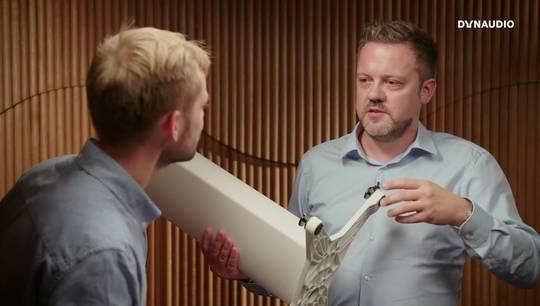
This is one of the questions
that we get most often,
and it'll probably not be the last time.
“How much space should I leave
between my speakers and the back wall?”
Basically, it depends on the room
just as much as the speaker itself.
So in reality, you have to experiment
a little bit with this.
What happens is,
if you put the speaker closer to the wall...
it will add some more bass.
So when the sound is dispersed
from the speaker,
the bass frequencies are
actually dispersed out
in all directions, like a sphere
from the loudspeaker.
So it'll travel out in all directions,
including backwards.
And the higher frequencies
is only going forward.
So if you put the speaker closer
to the wall,
you're going to increase the refelctions
of the low frequencies
from the back of the speaker.
So you have a balance between how close
do you want it to be on the wall,
to have a proper impact in the bass,
or to get it further out?
Then you have less reflections
from the wall,
but you also might have to lean sound
with too little bass.
So you kind of have to
experiment with that.
What I generally recommend is:
start by putting the speakers
really close to the wall,
which is very likely
not to be the best case.
And then gradually moving out,
listen to some music
that has some variables
and tuneful bass.
Figure out when does it sound best.
So as you move gradually outwards,
you'll be able to hear that it becomes better.
Sound is more easy to follow; the bass notes
and things like this,
so once it sounds better and better,
just keep increasing it
until at some point it's going to be worse.
The bass is going to be kind of missing
in the music.
So then, you know to go backwards a little bit.
That's the easiest approach
to reaching the optimal point.
Then you have some theoretical approaches
to the distance between the speaker
and the wall.
And just to touch on that a little bit...
One of the things that led us here
is something called SBIR,
which is speaker
boundary interference response.
And what that means is
the sound coming from
the back of the speaker hits the wall
and is then reflected back.
That sound is delayed
when it reaches the speaker again.
So that gets mixed with the sound
directly from the speaker.
So depending on the wavelength,
depending on the frequency of that sound,
it might actually cancel out
some of the sound from the speaker.
So from the speaker to you, some of
the sound will be missing, so to say.
And the distance directly affects
which frequencies are affected and
how much they're affected.
So that's the technical reason
that it's important to have
the right distance to the wall.
And again, that can be calculated.
But it's really more efficient in the real world
to do it by ear, in my experience.
Because the real world never really matches up
with the calculations,
because you also have to take into account
the distance to the sidewalls
and floors and ceilings
and listening position and all of that.
Another thing that's related to
this is: how about
the port placement of the speaker?
Sometimes this question is really focused
on the placement
of the port of the speaker.
The port is typically on the back.
So should I move the speaker out
from the wall because the port is
on the back?
So sometimes this question
is actually based in port placement.
People want to know,
does the port placement affect
how close my speaker is to the wall?
And actually, it isn't that important,
but I'm going to cover that
in a future episode of Ask the Expert.