Hey guys! My name is Christopher
and I am from Dynaudio.
Today we are in Munich for
the annual High End show.
And with me here in the
studio I have Georg.
Georg can you just say a couple
of words about yourself?
Yeah, I am a mechanical
designer here in Dynaudio.
And I try to basically facilitate the work
between the acoustic team and the designer.
- And make something that...
And make something that can actually
be produced and sound great.
But it is not me that makes it
sound great it is those guys.
Perfect...
Should we do the questions?
- Yeah, sure...
Okay Georg.
We have a question from Robert.
And he asks what kind of
analysis tools we use.
We use several different kinds of tools.
For example if we use…
If we want to make a simple
strength calculation
of for example the feet
for the new Contour line
We have a simulation tool that can be used
for rather simple linear calculations
so that when you take…
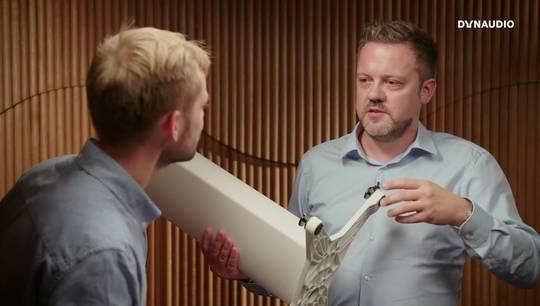
Lets take the Contour 60 for example which
is a speaker that weights about 50-55 kgs…
- It is a heavy speaker...
- It is a damn heavy speaker. Yeah…
And… You tend to – when you move
it around in your living room,
you tend to let it rest on one
leg and then slightly moving it.
So the feet has to cope with
the entire 50-55 kilos...
And that calculation tool makes it possible
for us to do some simple preliminary
calculations of whether or not the cast
feet, and this case it is cast-aluminum,
It can cope with the load.
So if it cannot cope with the load,
Then, we try to use the tools to find out
where we can improve the structure.
For example, we make the roundings
bigger to cope with the…
- … the force of the weight.
Yeah…
The stresses in that area…
So when you run a simulation like this...
What does it look like?
Because I have not seen one so...
I am curious to know
what it would…
Well we get a pinpointed...
chart afterwards where it is color
coded so that the high stress areas
are normally indicated by a color red
and non-stressed or
non-influenced areas are colored blue.
And from that - those pinpoints,
you can then say
“Ok, this is a weak area of the speaker”
- Exactly… Exactly…
And then you can go
and try to improve.
Yeah.
You can.
You can change the roundings. You can
make it thicker, you can do different
kind of adaptions, so that you can cope
with the stresses in a given area.
And does it also apply to…
You were talking about the feet now.
Does it also apply to for instance,
the woofer – so the cabinet itself?
Would you go in and analyse on that...
Yeah. You can do that as well.
We have a different tool called the COMSOL.
Which is Multiphysics tool where you can
analyze different aspects of the speakers.
Also the airflow through the
speaker and try to do some
calculations of the needed back port sizes
and stuff like that…
But it is all to find, I guess, to find
the weak areas and try to improve on that?
Yeah. It is.
And it is to make it a
better sounding product
first out of tool instead
of – for example the sixth version
where we tried different things.
In this way, we can get a
better first prototype.
And I guess that.. I know
that you as a mechanical
engineer you of course
work closely with
the acousticians and the
product management team...
They come with a lot of ideas and wishes
and then you have to kind of make it work
...in the real life right?
To find the compromise that fits…
It is not always easy though…
- No...
And I guess that a tool
like this makes that...
You talked about – you avoid having
to go through 6 different prototypes.
It helps us start closer to
the finish line I guess.
Yeah Yeah. It does. Of
course we always need to
make prototypes and
test it in the given situations but...
Because there might have been something
we didn’t take into account and...
When you are doing this
kind of calculations,
what you put in is
what you get out.
So if what you put in is
rubbish or it’s not done thoroughly
then what you
get out is useless.
So I guess the bottom line
is that we actually do a lot of analysis,
simulations and calculations to find out,
If the speaker is structurally
– I don’t know if that's the right word
sound and can hold up.
Yeah we do, we do…
- And it was FEA? Finite...
- FEA is called Finite Element Analysis
- OK and then COMSOL?
- COMSOL is the same but it
works with the Multiphysics.
So it takes more into consideration.
Whereas the other one we use for the
simple linear is a basic strength tool.
- OK. So it all depends on how –
on where in the process you are.
Which tool you would use…
- Yeah
- Yeah
- Exactly...
- Perfect!